Solving the N/P Ratio Challenge in Cylindrical Cells
The world is moving deeper into electrification. From defense, space, and robotics to AI infrastructure, energy storage, and electric mobility, more…
The world is moving deeper into electrification.
From defense, space, and robotics to AI infrastructure, energy storage, and electric mobility, more applications now depend on batteries. As this shift accelerates, the industry continues to search for the chemistries, materials, and cell technologies that can deliver higher energy, lower cost, longer lifetime, and enable large-scale production.
This is one of the reasons cylindrical cells have become such an important format. They offer strong mechanical stability, higher energy density, scalable production, and a clear path toward improved pack integration. At the same time, the industry is moving toward larger cylindrical formats, most recently the 46-series cells, including 4680 and 4695, as part of the broader effort to build batteries that can support electrification at scale.
But cylindrical cells also introduce internal geometry challenges. As formats become larger, managing these challenges becomes even more important.
Why Curvature Changes the Local N/P Ratio
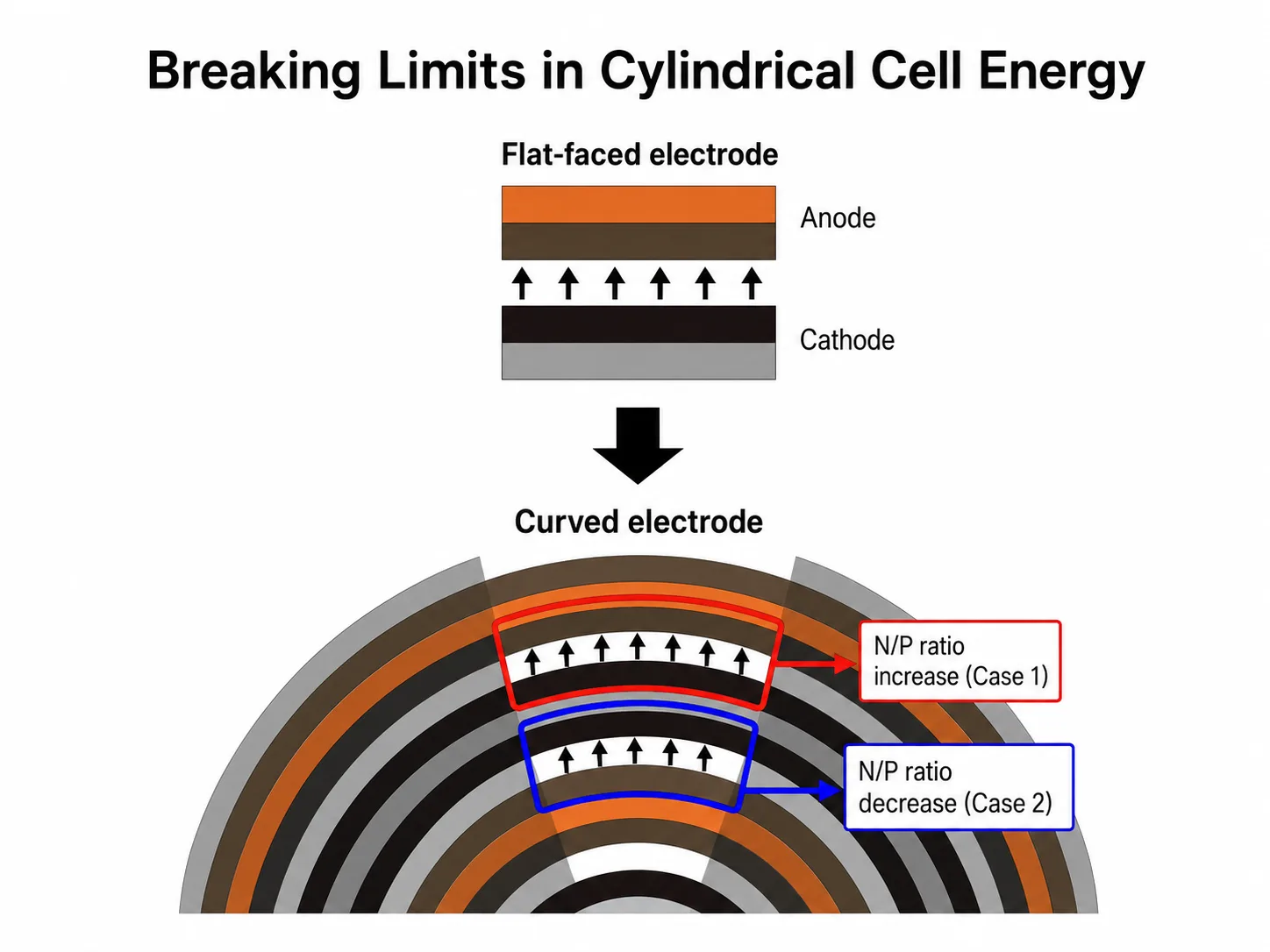
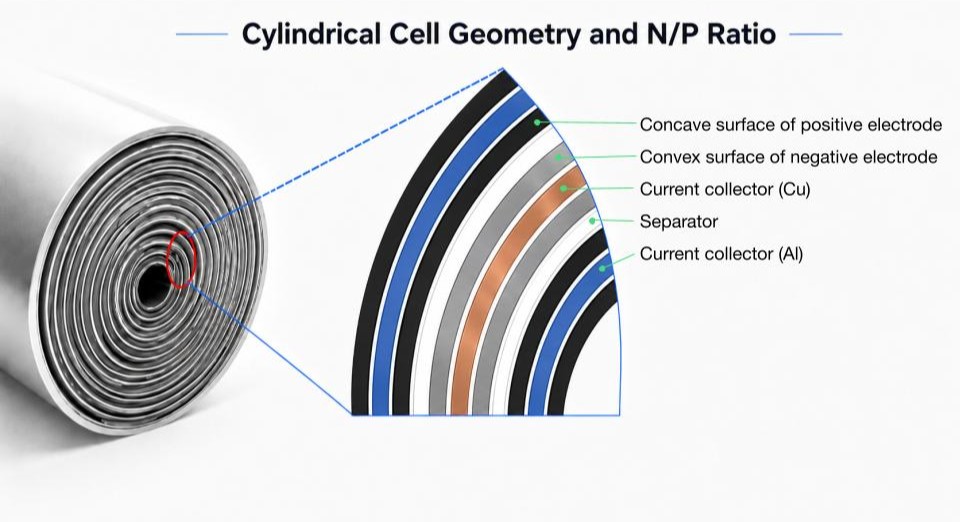
Inside every cylindrical cell, the electrodes are wound into a jelly roll. This structure is compact and manufacturable, but it also creates curvature. The inner layers are more tightly curved than the outer layers, making the local relationship between the anode and cathode less uniform.
That relationship directly affects the N/P ratio, the balance between the capacity of the negative electrode (anode) and the positive electrode (cathode). In flat cells, such as pouch cells, the contact area between the anode and cathode is relatively uniform. In cylindrical cells, the spiral structure changes that effective contact area at different radial positions, meaning the local N/P ratio can vary even when the cell is designed with a specific overall ratio.
Recent research published in Energy Storage Materials showed that this curvature-driven variation can lead to local electrochemical performance differences, capacity inconsistencies, and increased risk of lithium-metal deposition, especially in the inner regions of the jelly roll.
When the local N/P ratio is too low, the anode may not have enough available capacity to safely host lithium during charging. This increases the risk of lithium plating, capacity fade, degradation, and shorter cell lifetime, especially under high-voltage charging or low-temperature conditions.
This is why N/P ratio control in cylindrical cells is more complex than in flat cells. It is not enough to design the right global ratio; the cell must also account for local imbalance created by curvature.
How the Industry Manages the Problem Today
The industry manages this problem, but the solutions come with a cost.
The common approach is to add more anode material to maintain a safe N/P ratio throughout the cell. Commercial cells typically operate with an N/P ratio above 1, often around 1.05 to 1.10, meaning the anode is already designed with excess capacity. In cylindrical cells, curvature-driven imbalance can reduce the effective local N/P margin, which can require an even higher designed N/P ratio, often around 1.10 to 1.15.
Technically, it works. But the added material is used to compensate for a structural limitation, rather than to increase useful cell capacity. It takes volume, adds weight and cost, and reduces the space available for active materials that directly improve energy density. At large manufacturing scale, even a few percent of additional material becomes a significant inefficiency.
Another possible approach is asymmetric coating: applying different loading levels to different sides or regions of the electrode to compensate for the local effects of curvature. In theory, this is more targeted than adding excess material everywhere. In practice, it is difficult to implement in mass production because non-uniform coating creates challenges in downstream processes such as calendering, where pressure, thickness, and mechanical behavior must remain consistent.
A larger mandrel or middle void can also reduce curvature in the inner layers, but it reduces active volume inside the cell.
In each case, the industry manages the N/P ratio challenge by adding material, adjusting the cell design around the limitation, or accepting manufacturing complexity.
If cylindrical cells are going to support the next era of electrification, especially in electric mobility, the industry will need solutions that improve the internal architecture of the cell itself, without adding unnecessary material, volume, cost, or manufacturing complexity.
How Smart Metals Improve Cell Design and Manufacturing
In a standard electrode, the current collector is a solid metal foil. It conducts electrons and supports the active material, but from an electrolyte and lithium-ion transport perspective, it acts as a barrier between the two sides of the electrode. If there is a local imbalance on one side, that imbalance remains local.
Addionics’ Smart Metals, Porous 3D Current Collectors, replace the traditional flat foil with a conductive, porous, three-dimensional metal structure. Instead of acting as an impermeable layer, the current collector becomes part of the electrode architecture itself, creating designed pathways that support ion and electron transport through the structure.
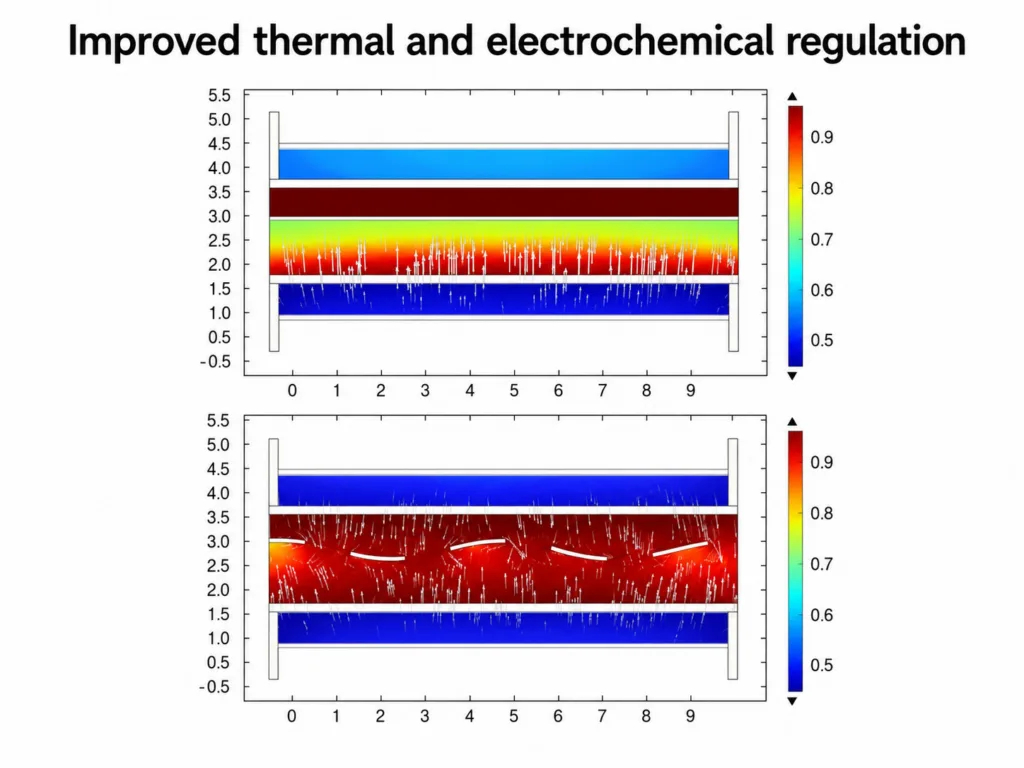
Because the structure is accessible to lithium ions, the current collector no longer acts as a fixed electrochemical boundary. Ion transport and reaction pathways can respond more flexibly to local conditions, helping the electrode function more like one integrated structure.
In cylindrical cells, this is especially important because it supports more uniform utilization, reduces local imbalance, and helps manage the curvature-driven N/P mismatch created by the jelly roll. By addressing part of the imbalance inside the electrode structure itself, manufacturers can reduce their dependence on external compensation strategies such as asymmetric coating, excess anode loading, or other design compromises.
Because Addionics’ current collectors are designed as a drop-in solution, manufacturers can integrate Smart Porous 3D Current Collectors into existing cylindrical cell designs without redesigning the entire cell or making major changes to the production process.
For high-volume cylindrical cell manufacturing, small inefficiencies in material use, coating complexity, or yield can become significant at scale. By improving transport and utilization from inside the electrode, Smart Metals can support better cell design, improved material efficiency, and more consistent manufacturing.