Cold Weather Is Already a Battery Business Problem
Cold weather already forces EVs, fleets, drones, and defense systems to trade range, time, and mission capability. The fix has to start inside the cell.

Cold weather is already forcing battery-powered systems to compromise.
EV drivers charge more often. Fleets add winter range buffers. Electric trucks may need additional charging stops on routes they complete more easily in warmer conditions. Defense units are seeing drone flight times drop in freezing environments. Across these applications, energy is being spent heating batteries instead of moving vehicles, carrying payloads, or completing missions.
This is where battery performance becomes a business and operational problem.
The Operational Cost of Cold
Winter range loss changes the economics of the same EV trip. A smaller range number on the dashboard can mean more charging stops, more time spent charging, higher energy costs, and less flexibility in where and when the vehicle can be used. In AAA's 2026 testing, EVs showed a 39.0% decrease in calculated driving range at 20°F compared with 75°F, while operating costs increased by $32.11 per 1,000 miles when charged at home and $76.93 per 1,000 miles when using public charging.
Fleet operators face the same challenge at a larger scale: vehicles must perform reliably under real operating conditions. A 2025 Virginia Transportation Research Council field study found that an electric pickup truck in VDOT operations performed well under standard conditions, but towing and cold-weather use created meaningful limitations, including a 50-70% range decrease during towing and measurable energy consumption during winter idling.
The impact becomes sharper in electric trucks, where lost range can quickly become lost time, lost payload flexibility, or lost revenue. An unexpected charging stop can affect delivery schedules, charger availability, vehicle utilization, and the economics of the route. Operators can compensate with larger packs, more charging built into the route, or wider operating buffers, but every option adds cost.
Cold conditions are also reducing mission capability in defense applications. During a U.S. Army winter exercise in Germany, the 10th Mountain Division found that freezing temperatures significantly degraded drone battery life, affecting flight time and the ability to employ some drones. According to the brigade commander, freezing temperatures cut some drone flight times in half. That kind of reduction changes the mission. Shorter flight time means less surveillance, shorter mission radius, more battery swaps, more recharging, and more power logistics pushed closer to the field. In defense, cold-weather battery performance can become a readiness issue.
The same pattern is already visible across robots, outdoor autonomous equipment, electric aircraft, and space platforms. When cold reduces battery capability, the system compensates through heating, insulation, conservative operating windows, added margins, larger packs, or more thermal-management hardware.
These solutions may be necessary, but they are expensive trade-offs. They add energy demand, weight, time, complexity, and cost. In many cases, the system carries battery capacity, hardware, and energy that are partly used just to maintain the conditions under which the battery can operate.
Solving the Problem Inside the Cell
The electrochemical issue begins inside the cell. At lower temperatures, electrolyte transport slows, reactions become more resistive, and lithium diffusion through active materials is reduced. As a result, the cell may reach its voltage limit before the active material is fully utilized, while cold charging can create localized conditions associated with lithium plating and irreversible degradation.
Dense conventional current collectors can make this worse by limiting through-plane electrolyte access, leading to less uniform reactions and underutilized electrode areas as temperatures fall.
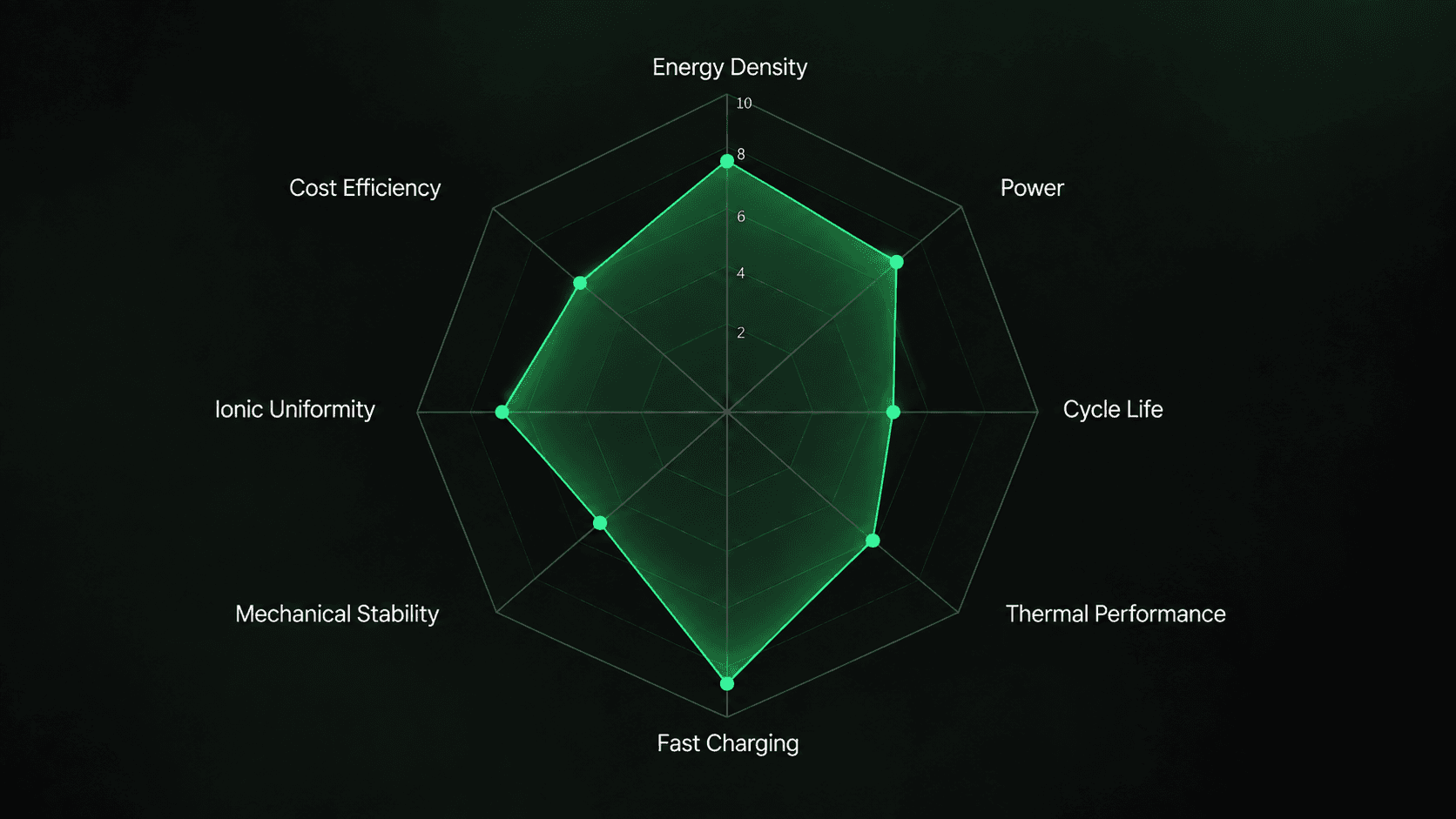
Addionics addresses this by changing the internal architecture of the cell. Smart 3D Porous Current Collectors create additional pathways for electrolyte and lithium ions through the current collector plane, shortening transport distances, improving access to active material, and helping more of the battery's capability remain usable in the cold.
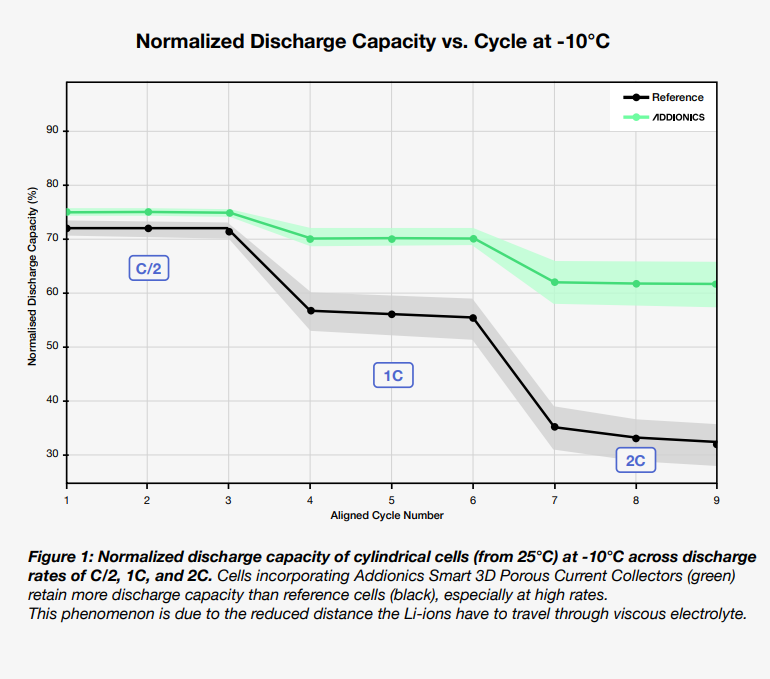
In testing at -10°C, cylindrical cells with Addionics Smart 3D Porous Current Collectors retained more discharge capacity than cells with conventional current collectors, especially at 1C and 2C. Under the tested discharge and charge conditions, Addionics cells at -10°C performed comparably to conventional cells at approximately 0°C.
When cold forces systems to spend more energy, time, weight, and cost just to maintain battery performance, the solution has to go deeper than external compensation. It has to start inside the cell.
Read our full white paper or visit our product page to learn more about Addionics' low-temperature battery architecture and technology.