The Robotaxi Era Is Changing What Batteries Need to Do
Robotaxi fleets run on a different logic than personal EVs: uptime, fast recharge, and thousands of intensive cycles. That changes what batteries need to do.

There are rare moments when technology stops feeling like an idea from the future and starts becoming part of the world around us. Robotaxis are entering that moment.
Today, Tesla is launching Cybercab in Austin, bringing a purpose-built autonomous taxi into the center of the mobility conversation. This is not happening in isolation. Waymo has already shown that autonomous ride-hailing can operate commercially at scale, while Uber is building robotaxi access into the ride-hailing model through partnerships.
This is a turning point for transportation. In the coming years, we will open an app and be picked up by a vehicle with no human driver, as autonomous taxis begin moving through the same streets as private cars, buses, trucks, and delivery vehicles.
Today's Batteries Are Not Built for the Autonomous Era
Most electric vehicles today are designed around human behavior. A person drives for part of the day, parks for long periods, and usually gives the battery natural rest time between cycles. A robotaxi operates under a completely different logic. It is a fleet asset, and its value depends on uptime, fast recharge, rapid redeployment, and reliable performance over time.
That changes the battery requirement. Range still matters, but it is no longer the full story. A robotaxi battery must support repeated driving, fast charging, heat management, limited rest, and thousands of intensive cycles. Charging time, cooling time, usable battery window, degradation, and lifetime all become part of the business model.
In a robotaxi model, downtime is lost customers. Every trip to a charger, every charging session, and every recovery window removes the vehicle from revenue-generating service.
Fleet simulations already show that charging-related empty travel is a measurable part of autonomous electric fleet operation. In one SAEV study on shared autonomous electric vehicles, shorter-range vehicles generated an additional 2.5% to 5.0% of total miles for charging activity, accounting for 23.6% to 35.4% of their empty miles. For longer-range vehicles, charging/refueling travel was lower, at 0.5% to 0.7% of total vehicle miles traveled.
This does not mean robotaxis are limited by batteries. It means the battery must evolve with the operating model.
Why Architecture Matters?
The first wave of robotaxi innovation focused on autonomy, sensing, software, safety, and manufacturing. As the market expands, the next question is how efficiently these vehicles can operate over time.
Fleet operators can compensate for battery stress with larger packs, more chargers, more thermal management, wider safety margins, or more vehicles. These solutions help, but they add cost, weight, infrastructure, and unused capacity. The stronger long-term path is to design batteries for the way autonomous fleets actually operate.
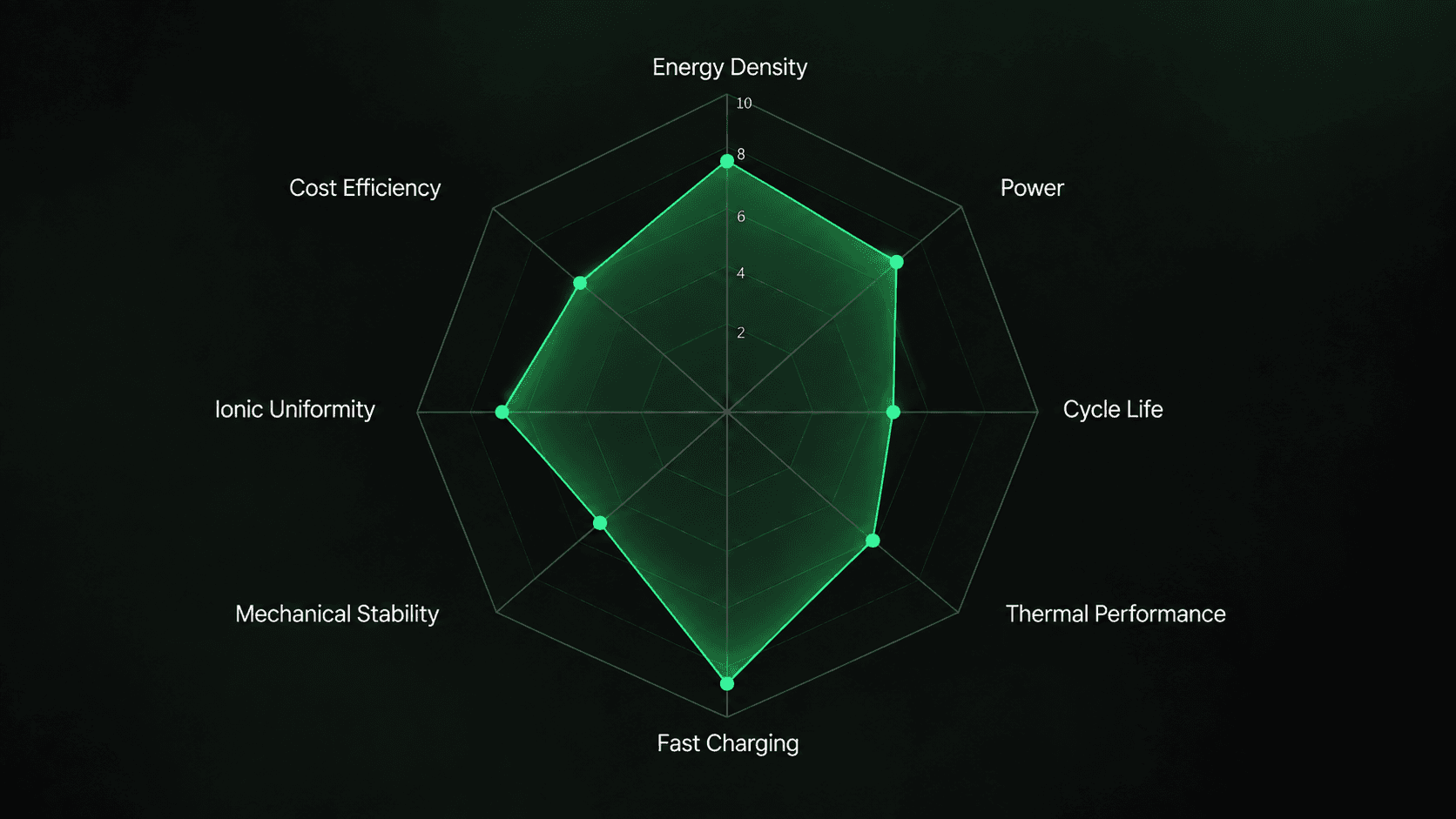
At the cell level, the challenge is transport. Conventional battery architectures were not designed for repeated high-utilization operation with limited recovery time. During cycling, electrolyte and ions move through the cell, but when rest time is compressed, uneven salt concentration can build up, a mechanism known as EMSI. Over repeated charge-discharge cycles, this imbalance can make parts of the electrode less accessible, increase localized stress, reduce usable capacity, and accelerate degradation. This is a main reason continuous 24/7 operation is so demanding for conventional batteries.
Addionics cell architecture can address this by creating additional pathways for ions and electrolyte, supporting more uniform activity and more stable continuous operation - and limits the EMSI phenomena.
Our advanced battery architecture allows a wider usable battery window, expanding it from 50% to 70% represents 40% more usable energy from the same battery pack, which can mean more operating hours between charging events or the same usable energy with a smaller pack. At fleet scale, reducing required battery capacity by approximately 29% could lower battery-related cost by about $5,000 per vehicle, or roughly $5 million across 1,000 robotaxis. You can dive into more details in our recent white paper on battery architecture for robotaxis and autonomous applications.
The Road Ahead
Robotaxis will change transportation because they change the economics of mobility. A vehicle that can operate without a human driver becomes more than a car. It becomes part of an intelligent, revenue-generating fleet.
The companies leading this market will compete on autonomy, cost, safety, user experience, regulation, and scale. But they will also compete on energy economics: how long each vehicle can stay in service, how quickly it can return to the road, how much usable energy remains available over time, and how long the battery can last under real fleet conditions.
The robotaxi era is not only changing who drives. It is changing the operating model of the electric vehicle itself.
And that means it is changing what batteries need to do.