How Smart 3D Current Collector Modeling Enables Next-Generation Batteries
As batteries are engineered around the specific demands of each application, modeling brings the current collector's geometry into the design process itself, instead of treating it as a fixed specification.
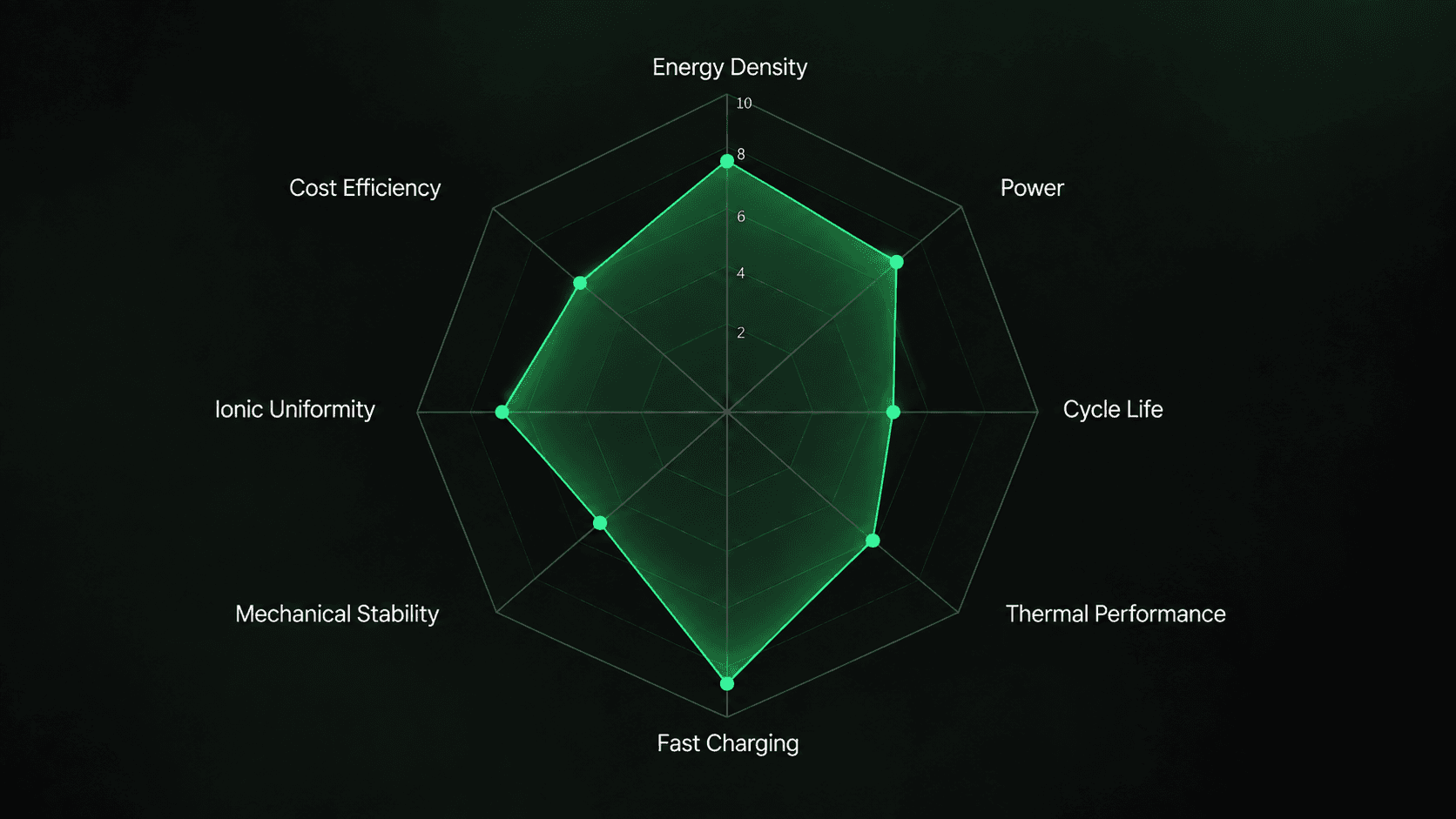
Technology is advancing faster than ever, and the applications batteries need to power are becoming increasingly demanding. Robotaxis and autonomous trucks need high power, fast charging and long operating hours. Satellites need to perform reliably for years in space. Defense systems may need to operate under extreme conditions, while robots are expected to work almost continuously with minimal downtime.
These applications do not ask the same thing from a battery. The industry is moving away from a one-size-fits-all approach toward batteries engineered around the specific demands of each application.
Designing batteries this way means balancing multiple performance requirements at once. Testing every possible combination physically is slow and expensive, which is why modeling has become essential: it helps engineers understand trade-offs, narrow the design space and predict how a cell is likely to behave before committing to physical builds.
Yet the current collector has traditionally remained largely outside that design process, treated more as a fixed specification than as an active engineering variable. Once it becomes porous and three-dimensional, however, its geometry becomes a key part of the battery design itself.
As a developer and manufacturer of Smart 3D Current Collectors, Addionics has built modeling capabilities specifically around understanding how current collector geometry affects battery performance. This allows us to begin with the performance the battery needs to deliver and work backward toward the architecture that can support it.
Modeling the Current Collector Inside the Battery
A Smart 3D Current Collector is not defined only by thickness, strength or conductivity. Parameters such as pore geometry, porosity, 3D structure and metal thickness can influence electrolyte transport, electrochemical behavior, resistance, mechanical response and electrode integration.
These parameters are also interconnected. A change that improves one aspect of performance may affect another, and the optimal architecture can vary between electrode designs, cell formats and applications.
Addionics' modeling team studies these interactions within the battery itself. Depending on the design question, the team can examine electrolyte movement, electrochemical behavior, mechanical response, wetting and manufacturing processes.
Over time, this builds a highly specialized understanding of the relationship between current collector geometry and battery behavior.
Moving Design Decisions Upstream
Without simulation, exploring a new current collector design requires producing material, integrating it into electrodes, building cells and testing them before knowing whether the direction is worth pursuing.
Modeling moves part of that decision-making upstream. It allows the team to identify the variables that matter most, compare design directions and select the architectures worth taking into production. Physical testing remains essential, but its role becomes more focused: to validate expected behavior, understand where reality differs from the model and improve the next design cycle.
We are bringing a semiconductor-style design methodology to the battery industry: simulate first, manufacture with intent, and use testing to confirm the design. This creates a more focused development cycle, with fewer unnecessary iterations and a clearer engineering hypothesis behind every test.
When the Battery Requirement Defines the Architecture
This approach also changes the technical conversation around the current collector.
Cell developers are used to evaluating current collectors through a specification sheet. With Addionics, the discussion can move from "Does this meet the specification?" to "What architecture best supports the product?"
That means explaining not only the properties of the current collector, but why a specific architecture was selected and what effect it is intended to create inside the cell.
Manufacturing is then used to realize that design, not simply to define it by what is easiest to produce. The architecture still has to be manufactured reliably and integrated into existing battery production, which is why modeling, product design and manufacturing remain closely connected.
For Addionics, the current collector specification is not the starting point.
It is the engineering output of understanding what the battery needs the current collector to do.
Visit our technology page to learn more about Addionics' Smart 3D Current Collectors.