The 100-Meter Problem in Battery Manufacturing
Electrode drying ovens can stretch 60 to 100 meters. How porous current collectors could cut drying time by up to 20%, saving factory space and energy.
A conventional electrode drying oven can stretch 60 to 100 meters across a battery factory. Heating it requires energy. Housing it takes valuable production space. Research estimates place coating and drying together at roughly 22% to 40% of the energy used in battery cell production, depending on the process.
For manufacturers working to lower the cost of every kilowatt-hour they produce, drying deserves attention. The challenge is to remove solvents faster while preserving the quality of the electrode.
Why drying takes time
During standard coating, active material is mixed with a binder and a solvent, such as water or NMP. The binder acts as an adhesive, holding the electrode together and attaching it to the current collector, the metal component that carries electrical current.
After coating, the liquid solvent must be removed. As it evaporates, the coating shrinks. Because the coating is attached to the metal surface, it cannot shrink freely, and stresses can build until it cracks, much like drying mud. This becomes particularly challenging in thicker coatings designed to hold more active material.
The moving solvent can also carry binder toward the surface where evaporation occurs. This can leave too much binder near the surface and too little elsewhere, weakening adhesion and increasing resistance. This is known as binder migration. Manufacturers therefore control heat and airflow carefully. Giving the coating more time to dry can help preserve quality, but it also limits line speed or requires a longer oven.
Changing how the coating dries
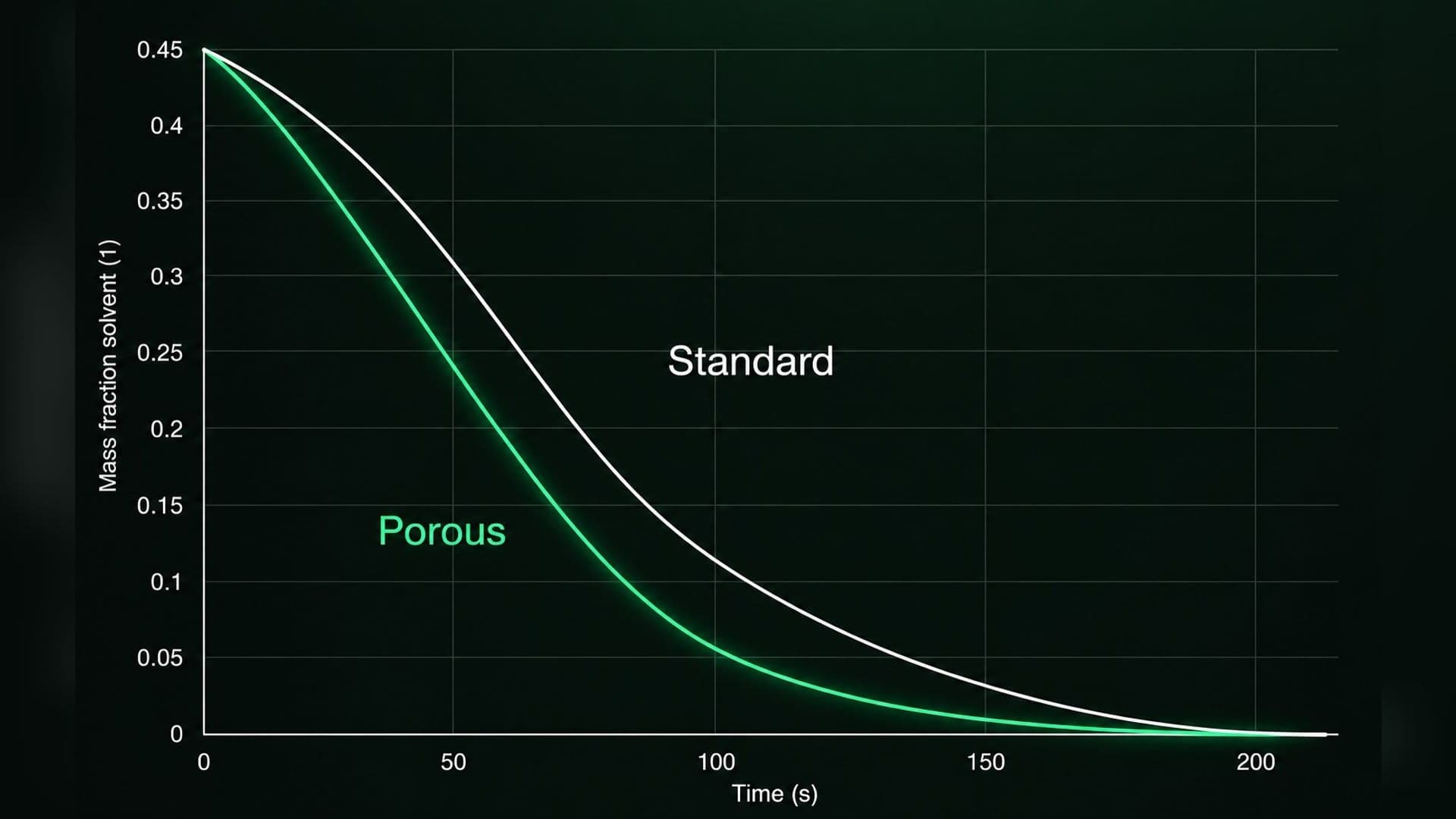
Addionics approaches this challenge through the structure of the current collector. Its Smart 3D Porous Current Collectors allow hot air to pass through the metal structure and support faster solvent removal. Under the same drying conditions, the local partial pressure of solvent vapor inside the coating was 30-50% lower with Addionics’ current collectors than with a conventional current collector. Addionics has also measured more uniform heat distribution during drying.
At a given temperature, solvent evaporates more readily when the surrounding air contains less of its vapor. The porous structure provides additional pathways for vapor to escape, while more uniform heating supports drying throughout the coating.
For the water-based anode configuration assessed, Addionics’ electrode-drying work indicates up to a 20% reduction in drying time.
What 20% means on the factory floor
That time saving gives manufacturers options. At the same line speed, a 20% shorter drying time could, in principle, reduce a 100-meter active drying zone to 80 meters and save 20% of the drying energy expenses. That is 20 meters less heated equipment to accommodate.
Alternatively, keeping the same oven length could theoretically support 25% more throughput through the drying stage: reducing the required time from 100 to 80 seconds allows 1.25 times as much material to pass through.
These are engineering illustrations. Achieving them on a production line requires the same final dryness and electrode quality, with the dryer and surrounding equipment able to handle the operating conditions.
Both options create opportunities to improve factory economics. Energy savings depend on how heating, airflow and solvent handling are managed, while a shorter dryer can reduce space requirements and higher throughput can improve equipment utilization.
The value of better electrode architecture begins on the factory floor, in the time, energy and space required to produce each cell.