Addionics Reports Reduced EMSI Effects in Cylindrical Cells Tested at Avrion Battery Labs, Solving Battery Degradation While Operating Continuously
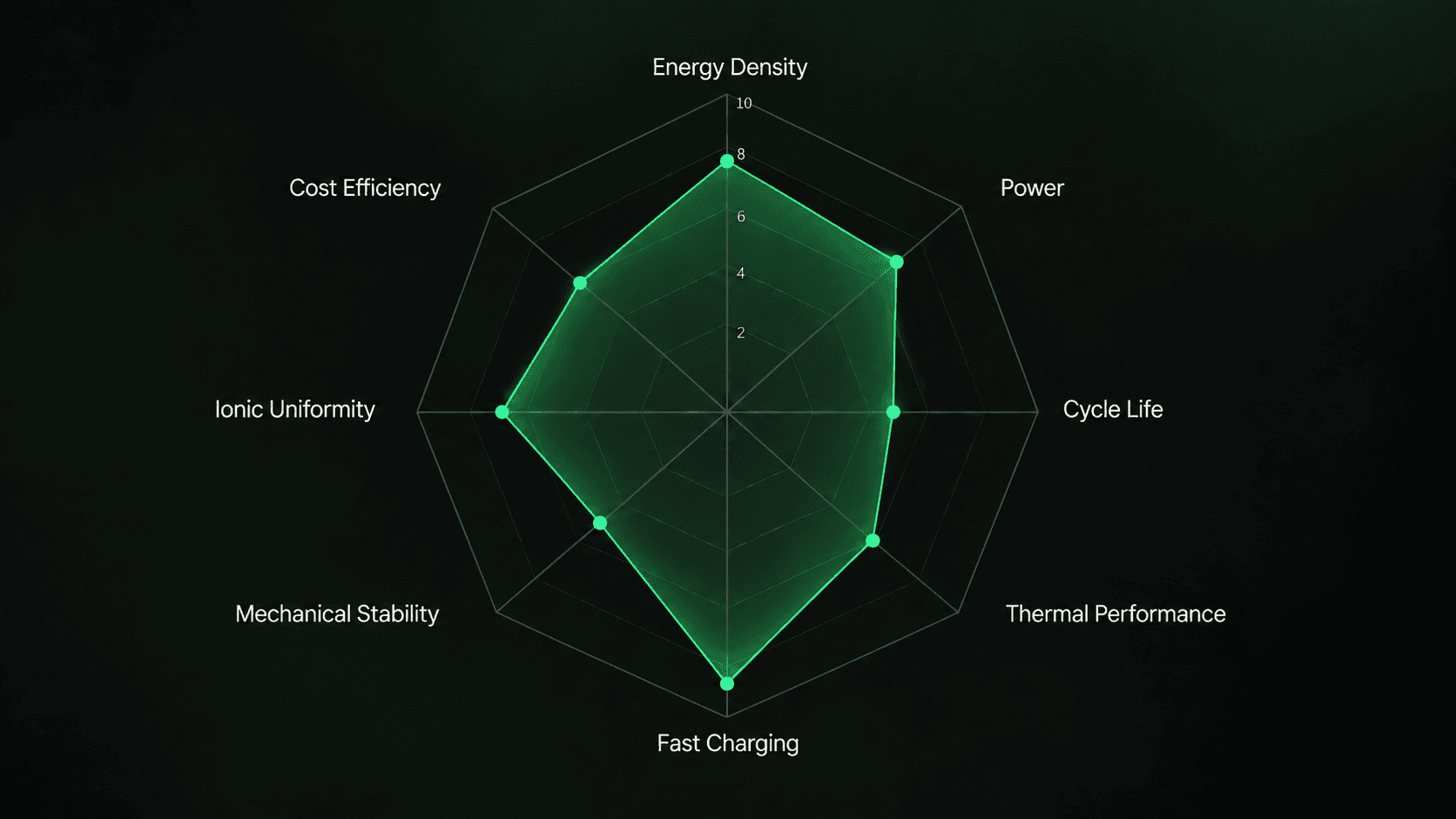
Addionics cells reached about 3.5 times the cycles before end of life in a case study with Avrion Battery Labs, and recovered faster during rest.
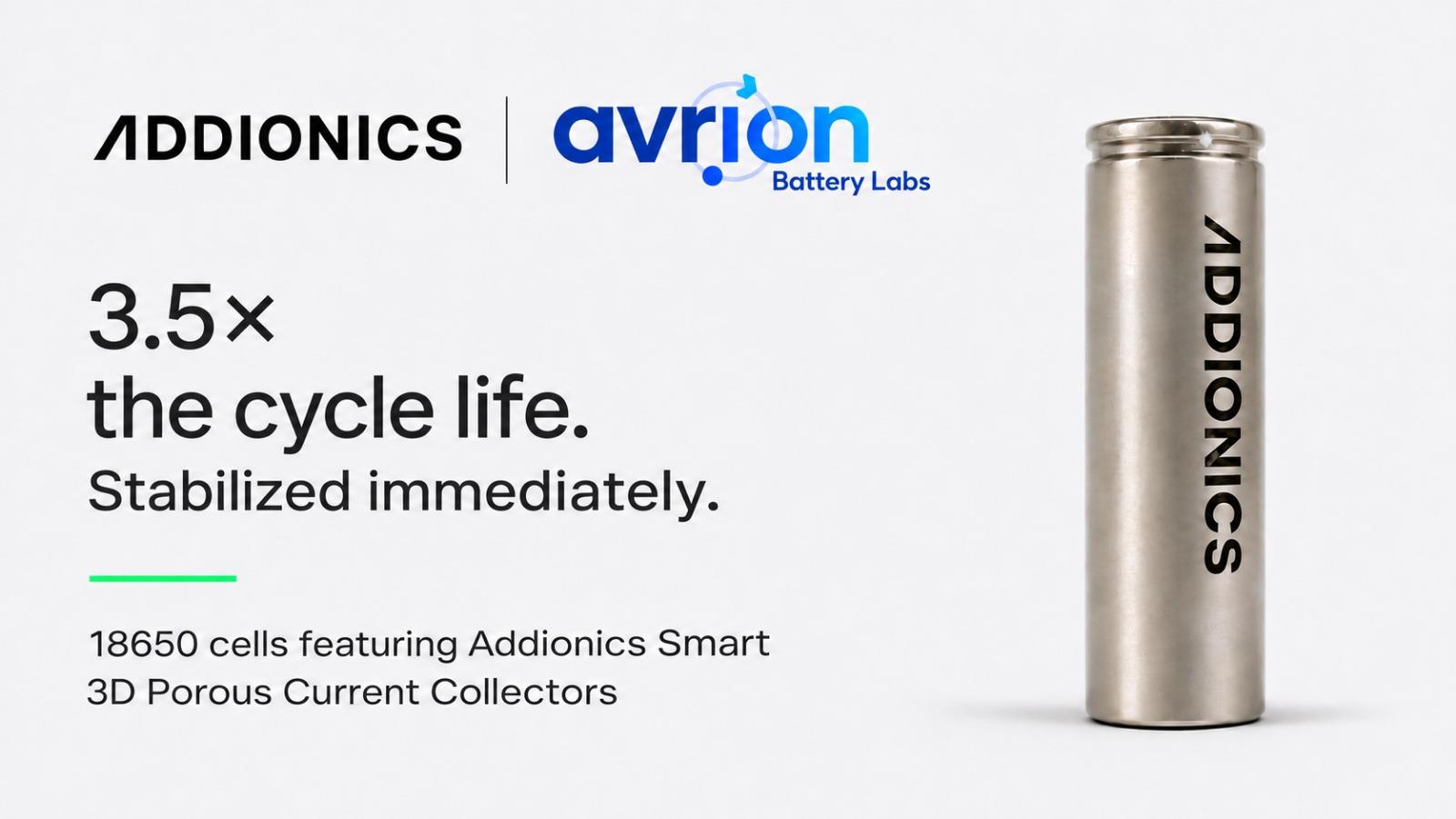
Addionics, a developer of 3D porous current collectors for lithium-ion batteries, announced results from a case study conducted at Avrion Battery Labs showing longer cycle life and reduced electrochemical signatures associated with electrolyte motion induced salt inhomogeneity (EMSI). These results demonstrate that Addionics is solving one of the biggest challenges related to battery degradation in the industry, enabling an always-on AI and autonomy industry.
The cells incorporating Addionics current collectors reached approximately 3.5 times the number of cycles before end of life, defined as 80% state of health, compared with reference cells using conventional current collectors. During rest, Addionics cells recovered in less than 2 hours initially and less than 12 hours by cycle 200, whereas reference cells required more than 48 hours after the first 20 cycles. These results are consistent with faster equilibration of electrolyte salt concentration.
Many established lithium-ion battery applications, including phones, laptops and cars, allow periods of rest or slower charging and discharging. Autonomous vehicles, humanoid robots and low Earth orbit (LEO) satellites increasingly demand sustained operation with limited opportunities for rest. In these applications, downtime can reduce availability and carry substantial operational costs.
The Avrion case study demonstrates the potential of Addionics’ porous current collectors to support these demanding operating profiles by extending cycle life and reducing the time needed for recovery during rest. Avrion provided the experimental platform for the study, including successful roll-to-roll electrode coating and fabrication of the graphite/NMC 18650 cylindrical cells. Testing used Avrion’s ultra-high precision coulometry (UHPC) equipment alongside Gamry instrumentation to track cycling performance and electrochemical impedance. Bringing cell fabrication and precision characterization together at Avrion enabled Addionics to evaluate collector architecture in a practical wound-cell format.
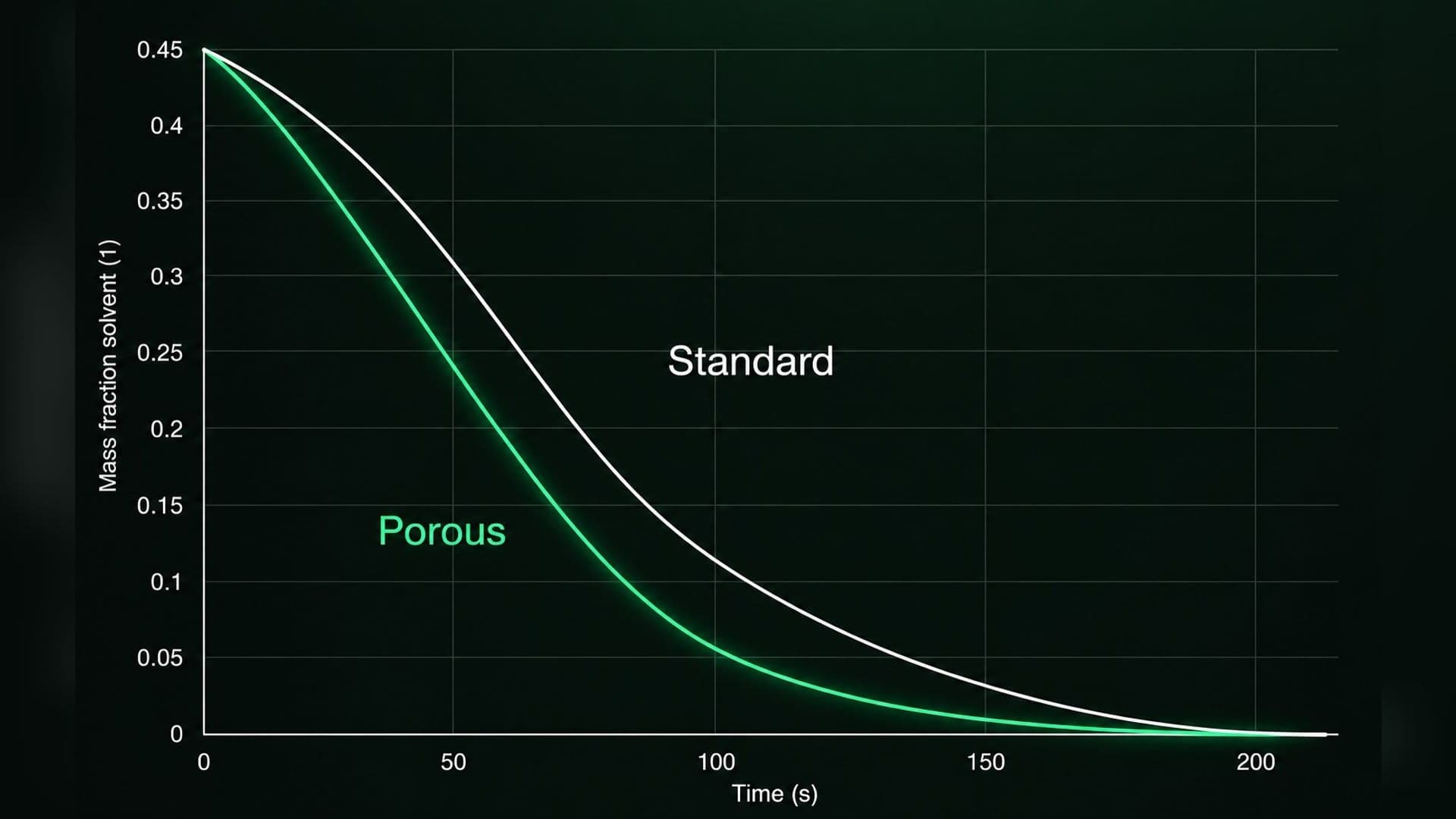
Addionics current collectors can reduce the relaxation time of diffusion by up to a factor of 10,000 by reducing the diffusion distance. A simplified diffusion model: t ≈ L²/2D, where t is a characteristic relaxation time, L is diffusion length and D is the effective salt diffusion coefficient. Any reduction in diffusion length has a squared effect on relaxation time. In a standard 18650 cell with conventional current collectors, the salt concentration gradient caused by EMSI must relax across the length of the jelly roll from the center to the top and bottom of the cell—a distance of up to 32 mm. With porous current collectors, the electrolyte flows directly through the electrodes and collectors rather than being forced toward the ends, reducing the diffusion pathway to approximately 400 micrometers. This reduction in diffusion time is expected to be even more significant in larger format cells.
Discharge capacity and resistance relaxation results
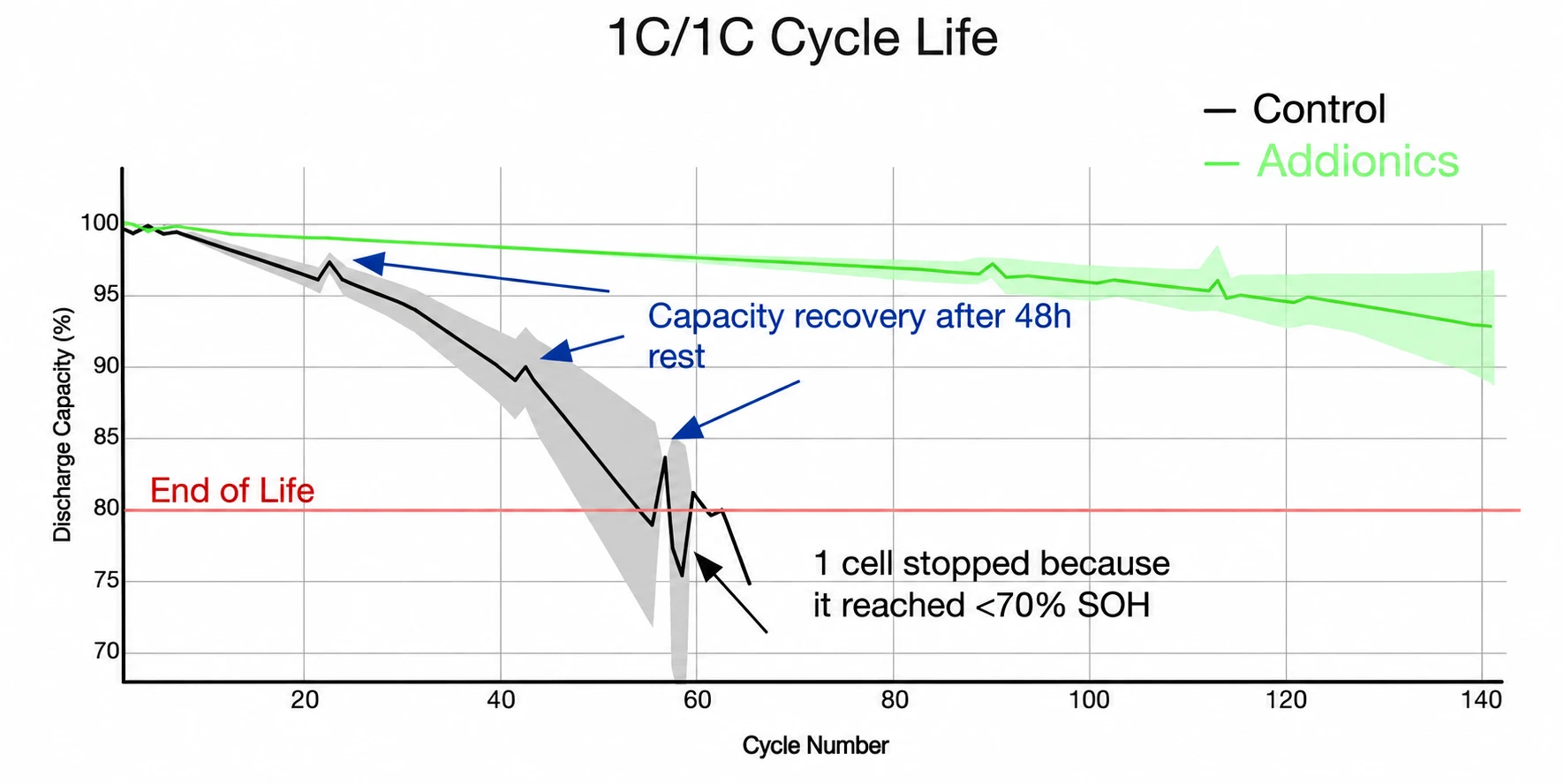
Cells incorporating Addionics current collectors demonstrated longer cycle life and less capacity recovery after rest. These responses are consistent with reduced accumulation of reversible salt concentration gradients during cycling for cells with Addionics current collectors.
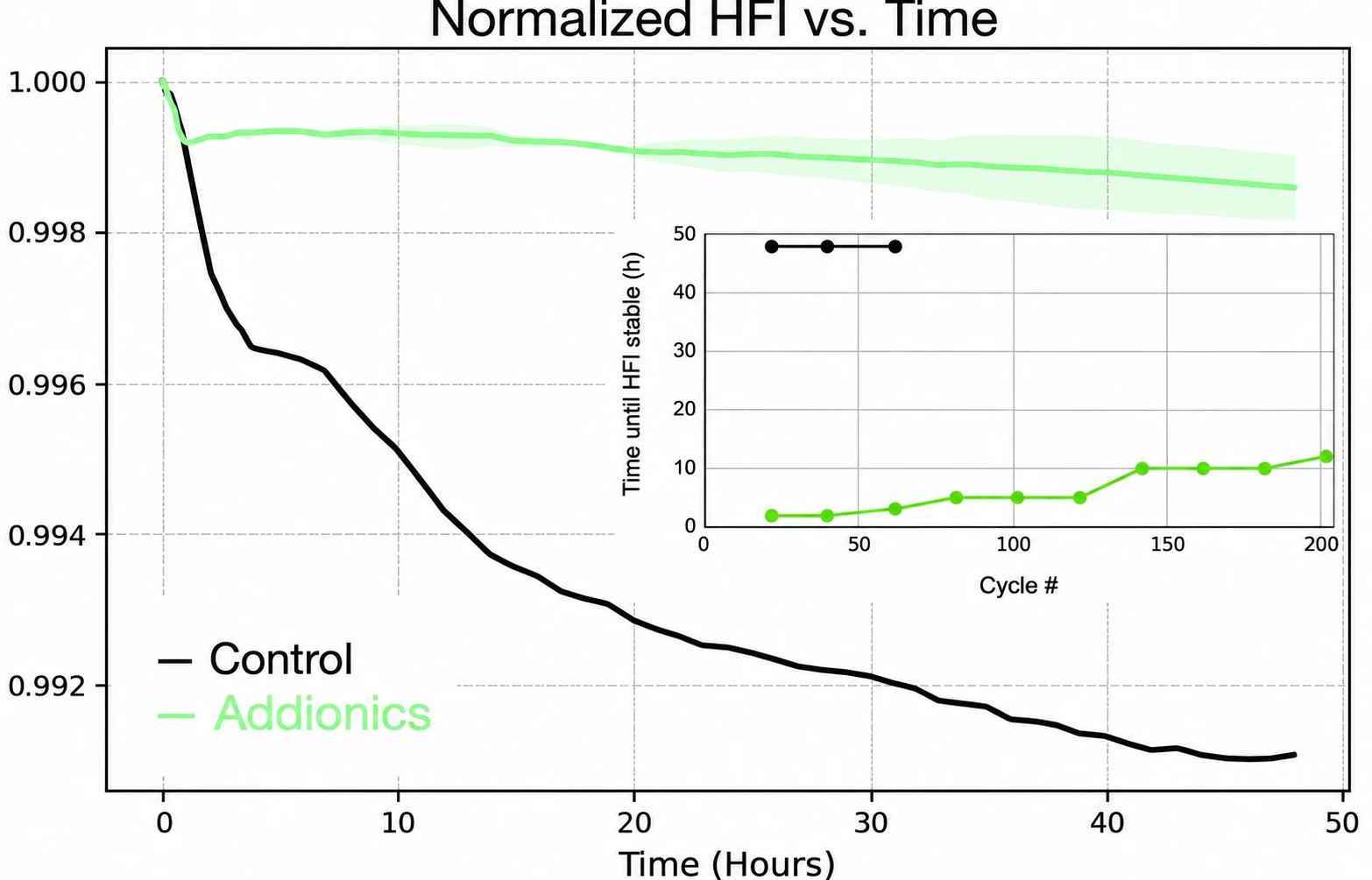
Together, the capacity and HFI responses support faster salt concentration relaxation with porous current collectors. Direct salt distribution measurements are planned to further test this mechanism.
Shortening electrolyte redistribution pathways
EMSI develops when electrode expansion and contraction move electrolyte in the presence of salt concentration gradients. Repeated cycling can redistribute salt over centimeter-scale distances, increasing resistance and reducing accessible capacity. Published work from Johannes Wandt (BMW AG and University of Agder) and from Jeff Dahn (Dalhousie University) with collaborators at Tesla, have linked this mechanism to capacity loss and localized lithium plating. [1, 2]
Conventional solid metal foil current collectors block direct electrolyte transport across the current collector, leaving longer pathways for redistribution within the jelly roll. Addionics’ porous architecture introduces through-plane pathways through the current collector, allowing electrolyte and salt to redistribute across electrode layers. The engineering objective is to shorten the distance over which concentration gradients must relax.
Implications for battery engineering
The results support further development of current collector architecture as a way to manage internal electrolyte transport. This approach is relevant to applications with repeated cycling and limited rest, including robotics and autonomous fleets. It also motivates testing under other transport-limited conditions, such as low temperatures, larger cell formats and thicker electrodes. At Avrion, Addionics tested performance in 18650s down to -10C, where we see improved performance at high rates and low temperatures.
Cell design and test conditions
Avrion fabricated two groups of 18650 cylindrical cells using NMC811 cathodes and graphite anodes: a control group with conventional current collectors and a group incorporating Addionics 3D porous current collectors. The cells were evaluated under the following conditions.
| Property | Value |
|---|---|
| Cell format and C/3 capacity | 18650 cylindrical; 2.7 Ah |
| Cathode and anode | NMC811 / graphite |
| Cathode single-side reversible areal capacity | 4.5 mAh/cm² |
| N/P ratio | 1.1 |
| Voltage window | 2.8–4.2 V |
| Charge and discharge rates | 1C / 1C |
| Test temperature | 25 °C |
| Electrolyte | 1.2 M LiPF₆ in EC:EMC:DMC (25:5:70 wt%) + 2% VC |
| Electrolyte fill factor | 1.3 × total pore volume |
Every 20 cycles, cells rested for 48 hours while periodic electrochemical impedance spectroscopy (EIS) tracked the high-frequency intercept (HFI), a measure of cell ohmic resistance. The procedure was inspired by the cylindrical-cell EMSI study by Jeff Dahn and collaborators. [2]
The Business Use Case
For autonomous taxis and electric fleets, battery performance directly affects vehicle cost and revenue-generating uptime. Addionics’ illustrative model shows that expanding the usable battery window from 50% to 70% could deliver 40% more usable energy, or meet the same energy requirement with approximately 29% less battery capacity. Assuming $50,000 vehicles with batteries representing 35% of cost, the smaller packs could save about $5 million across 1,000 autonomous taxis. In a separate space example, extending a $5 million satellite’s operating life from five to six years would add a productive year without another build or launch, improving the return on an asset already in orbit.
About Addionics
Addionics develops 3D porous metal current collectors that change the internal architecture of lithium-ion batteries to improve transport and performance. Learn more at addionics.com.
About Avrion Battery Labs
Avrion Battery Labs provides battery research and development services, cell prototyping and ultra-high precision testing equipment. Its capabilities connect materials evaluation, cell fabrication and electrochemical characterization. Learn more at avrionlabs.com.
Research references
[1] Solchenbach et al. Electrolyte motion induced salt inhomogeneity – a novel aging mechanism in large-format lithium-ion cells. Energy & Environmental Science 17, 7294–7317 (2024). DOI 10.1039/D4EE03211J
[2] Donais et al. Electrolyte Motion Induced Salt Inhomogeneity in Si-Containing Cylindrical Cells – A Case Study. Journal of The Electrochemical Society 173, 050519 (2026). DOI 10.1149/1945-7111/ae4b6e